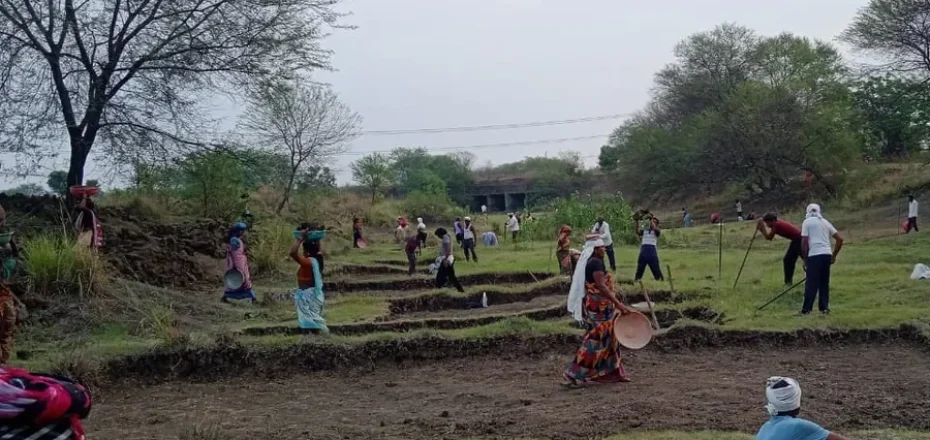
On December 18, 2025, the Indian government passed the Viksit Bharat—Guarantee for Rozgar and Ajeevika Mission (Gramin) (VB-G Ram G) bill in both houses of the parliament, proposing to replace the nearly two‑decade‑old Mahatma Gandhi National Rural Employment Guarantee Act (MGNREGA). The bill promises 125 days of wage employment—25 more than the current guarantee—alongside weekly wage payments and digital governance reforms. Yet, beneath these headline improvements lies a fundamental restructuring that has triggered fierce debate among economists and policymakers. Does this new law modernize India’s flagship social protection program, or does it dismantle the rights‑based architecture that has sustained millions of rural households through natural disasters and economic downturns?
As a researcher documenting the lived realities of MGNREGA workers in rural India, this is not an abstract question. For women like Kusum‑bai, a landless worker I met in Chandrapur, Maharashtra, while doing my fieldwork, the job card is not just administrative paperwork; it is a lifeline that prevents distress migration when local farm work dries up. The new law will shape what that lifeline looks like for her and millions of others.
More days, faster pay, “better” assets
At first glance, VB‑G Ram G appears to strengthen rural employment guarantees. The increase from 100 to 125 days potentially raises annual household earnings by 25%, a significant bump for families at the bottom of the income distribution. In Maharashtra, where the current MGNREGA wage rate is $3.5 per day for 2025–26, a household completing 125 days could earn roughly $433 annually, compared to $347 for 100 days, a theoretical gain of $87. For households in Arunachal Pradesh and Nagaland, where wage rates are around $2.7 per day, the additional 25 days still translate into over $67 a year, enough to cover a year’s school fees or an emergency hospitalization.
The shift to weekly wage disbursement is also welcome. Under MGNREGA, wages are supposed to be paid within 15 days of muster roll closure, but field studies consistently document delays stretching months, particularly in areas with weak banking infrastructure. Research shows how such delays undermine the scheme’s role as a consumption‑smoothing mechanism, forcing households to borrow at high interest while waiting for wages. If implemented with adequate banking and fund‑release systems, weekly payments could reduce emergency borrowing and make the program more compatible with people’s cash‑flow needs.