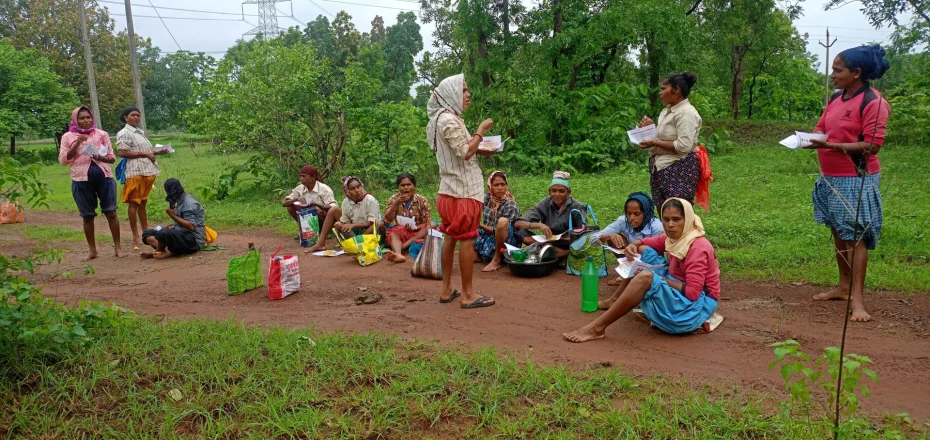
During my fieldwork in rural Maharashtra in 2025, I sat with a group of women in Chandrapur district. I had been working in the area for two years, studying the employment guarantee program that promises rural households wage work and reserves at least a third of it for women. I had seen the delays, the inadequate worksites, the barriers that kept many women from showing up at all. Several women in that room had encountered those barriers firsthand. One of them, a farmer’s wife in her late thirties, pulled out her phone and showed me her Jan Dhan passbook. ₹1,500 credited. She had not filled a form asking how she would spend it. She had not promised to send her child to school or attend a health camp. The government had simply sent it. She used part of it to buy medicines for her mother-in-law, part to repay a small loan from her self-help group, and kept the rest. It felt good, she said, to have something that was hers.
Here was a program that paid them simply for being women who managed households, with no conditions attached. No worksite, no muster roll, no delay. Just money in an account. That contrast is what this article is about.
The Global Precedent and the Indian Iteration
The Indian state did not invent this. Brazil’s Bolsa Familia (2003) and Mexico’s PROGRESA (1997) proved that conditional cash transfers, tied to school attendance and health checkups, reduce child poverty when the services they require actually exist and function. Peer-reviewed evaluations of Kenya’s GiveDirectly program found that unconditional transfers to women go overwhelmingly toward food, medicine, and household assets, with measurable improvements in household consumption and food security, directly contradicting the political argument that cash transfers are wasted. Across these programs, one finding recurred consistently: when cash goes directly to women, it reaches the household’s most vulnerable members first.
India has built its own version in the form of Unconditional Cash Transfers (UCTs), programs that send money directly to women’s bank accounts with no conditions attached. Whether this reflects trust in women’s judgment or a missed opportunity to link spending to outcomes is a question the evidence does not fully resolve, partly because the public systems that conditionality would require women to access remain unreliable in many of the villages where these transfers are most needed.
Goa, 2013: The Seed Nobody Watered
In January 2013, the Goa government quietly launched Griha Aadhar: ₹1,500 (approximately $18) per month to married women from households earning under ₹3 lakh annually. No work requirement, no conditionality. The scheme ran for nearly a decade before the rest of India took notice.
That silence tells its own story. In India, welfare innovations travel not through evidence but through electoral demonstration. Goa was too small, too affluent, and too politically marginal to trigger imitation. It would take a pandemic, and then a state election, to change that. It is also worth noting that ₹1,500 in Goa was never calculated against what care work is actually worth. It was linked loosely to rising household prices, framed as relief against inflation rather than as recognition of labor. That absence of a principled logic for the amount would follow every scheme that came after.
Assam, 2020: Emergency Relief That Became Policy
In October 2020, in the middle of COVID-19’s economic devastation, Assam launched Orunodoi: ₹830 (approximately $10) per month to women from vulnerable households. The motivation was practical. Women’s Jan Dhan accounts, opened under the national financial inclusion drive, were the fastest channel to move money. It was emergency relief before it was welfare policy.
What distinguished Assam from what came after is that it was not, at launch, an electoral instrument. The scheme was built in a crisis, expanded twice on its own merits, and only later became a template that other states deliberately copied for political effect. By 2025, Orunodoi 3.0 reached 3.7 million women at ₹1,250 (~$15) per month, consuming approximately 3% of the state budget annually. That sequence matters: Assam demonstrated that a women’s transfer could generate sustained political goodwill. Madhya Pradesh showed that you could engineer the same effect deliberately.
Madhya Pradesh, 2023: The Scheme That Changed Everything
In March 2023, the Madhya Pradesh government launched Ladli Behna: ₹1,000 per month to married women aged 21 to 60 from households earning under ₹2.5 lakh. The chief minister at the time traveled across the state for eight months, connecting the scheme to his political identity. In December 2023, the ruling party won a landslide.
SBI Research attributes approximately 3.67 lakh additional women voters in 2023 to the scheme. Female voter turnout rose from 74% in 2018 to 76% in 2023. In closely contested seats, the effect on incumbent retention was striking. The chief minister said, the day before polling: “In a close fight, Ladli Behna has removed the thorns in our path.”
Every party strategist in India read those numbers. Madhya Pradesh had proven, in a large Hindi-heartland state, that paying women wins elections. That became the real policy transmission mechanism: a vote count, not a welfare evaluation.
The Flood: 2023 to 2025
After the night of December 3, 2023 in Bhopal, the pace was relentless. The tables below show where things stand as of early 2026, with a deliberate distinction between schemes that are actually delivering money and those that exist primarily as announcements.
Tier 1: Operational Schemes
| State | Scheme | Launch | Monthly amount | Beneficiaries |
|---|---|---|---|---|
|
Goa |
Griha Aadhar |
Jan 2013 |
₹1,500 (~$18) |
0.15 million |
|
Assam |
Orunodoi |
Oct 2020 |
₹1,250 (~$15) |
3.7 million |
|
West Bengal |
Lakshmir Bhandar |
Aug 2021 |
₹1,000–₹1,200 (~$12–$14) |
22 million |
|
Madhya Pradesh |
Ladli Behna |
Mar 2023 |
₹1,500 (~$18) |
13 million |
|
Karnataka |
Gruha Lakshmi |
Aug 2023 |
₹2,000 (~$24) |
12 million |
|
Tamil Nadu |
Kalaignar Magalir Urimai |
Sep 2023 |
₹1,000 (~$12) |
11 million |
|
Chhattisgarh |
Mahtari Vandan |
Mar 2024 |
₹1,000 (~$12) |
7 million |
|
Jharkhand |
Maiya Samman |
Aug 2024 |
₹2,500 (~$30) |
5.7 million |
|
Maharashtra |
Ladki Bahin |
Aug 2024 |
₹1,500 (~$18) |
24.6 million |
|
Odisha |
Subhadra Yojana |
Sep 2024 |
₹833 (~$10) |
12 million |
But announcing a scheme and delivering it are two different things, as a second tier of states demonstrates:
Tier 2: Announced, Undelivered, or Partial
| State | Scheme | Announced | Promised amount | Status (Early 2026) |
|---|---|---|---|---|
|
Himachal Pradesh |
Indira Gandhi Pyari Behna |
Feb 2024 |
₹1,500 (~$18) |
Approx. 48,000 women received first installment by mid-2024; payments remain pending across multiple districts |
|
Delhi |
Mahila Samriddhi Yojana |
Mar 2025 |
₹2,500 (~$30) |
Cabinet approved; ₹5,100 crore budgeted; zero rupees transferred as of January 2026 |
|
Telangana |
Mahalakshmi (cash component) |
2023 |
₹2,500 (~$30) |
Free bus travel operational; UCT is not confirmed as systematically disbursed |
Together, the ten fully operational schemes cover approximately 120 million women, one of the largest cash transfer experiments for women anywhere in the world by beneficiary count. The Tier 2 cases, however, tell an equally important story. Delhi announced its scheme on International Women’s Day 2025, days after winning the state assembly election. Nearly a year later, not one rupee had been transferred. Announcing a UCT for women has become politically valuable in itself, independent of whether any transfer materializes.
The Fiscal Reality and the Design Flaw
The Economic Survey 2025-26 puts the numbers plainly: states will spend an estimated ₹1.7 lakh crore on women’s UCTs in FY26, up fivefold from FY23. According to the same Survey, nearly half the states running these schemes are already in revenue deficit, and UCTs now consume between 3% and 9% of state budgets.
Maharashtra offers the clearest live demonstration of what comes after the electoral proof of concept. In June 2024, BJP, the lead party of the ruling Mahayuti alliance, was reduced from 23 Lok Sabha seats in 2019 to 9, a result widely attributed to the alliance’s poor standing among rural and women voters. Within weeks, the state government launched Ladki Bahin in August 2024, ahead of the November state assembly election, which the alliance won decisively. By early 2025, the government reduced Ladki Bahin payments to ₹500 per month for 7.74 million women enrolled in the Namo Shetkari Mahasamman Nidhi, Maharashtra’s state-level farmer support scheme. Namo Shetkari, combined with the central government’s PM Kisan Samman Nidhi, gives a registered woman farmer ₹12,000 per year, paid in three instalments of ₹4,000 every four months. Maharashtra’s official Government Resolution for Ladki Bahin caps a woman’s total monthly welfare support across all government schemes at ₹1,500. For women who themselves hold Namo Shetkari registration, the annualised farmer benefit averages ₹1,000 per month, so Ladki Bahin is topped up to only ₹500. The scheme has since contracted sharply: 86 lakh fewer women received payment by early 2026, largely due to eKYC re-verification requirements, and the total outlay was reduced from ₹46,000 crore in the July 2024 budget to ₹36,000 crore in 2025-26. But the more consequential change is in the design of who receives what and why.
The design implication becomes clear when you trace what the scheme’s rules produce across three different situations, all of which were present in that Chandrapur focus group. A woman who holds land in her own name is registered under Namo Shetkari, receives ₹1,000 from the farmer schemes, and gets ₹500 from Ladki Bahin, totaling ₹1,500 per month. A woman whose land is in her husband’s name cannot access the farmer schemes and receives the full ₹1,500 from Ladki Bahin alone. Now consider what the rules produce for a widow who has just inherited her husband’s land. Before his death, the household received ₹1,000 from the farmer schemes in his account and ₹1,500 from Ladki Bahin in hers. Once she formalizes the land transfer and enters the farmer database in her own name, her Ladki Bahin drops to ₹500, reducing her total monthly welfare income by ₹1,000 at the moment she has just lost her husband, is managing a farm alone, and needs money most. The scheme provides no grace period for life events of this kind and no provision for case-by-case review. Maharashtra does operate separate widow pension schemes, but these are restricted to households below the poverty line with annual incomes under ₹21,000. A widow who inherits agricultural land and enters the farmer support database is typically assessed above that threshold and does not qualify, leaving her precisely in the gap the welfare architecture has not addressed. What the rules produce, however unintentionally, is a structure in which formal land ownership in a woman’s name generates less total welfare income than land held in a male name, which is precisely the opposite signal that land titling reform is meant to send.
The Economic Survey recommends shifting to conditional, time-bound transfers modeled on Brazil’s Bolsa Familia. This deserves serious consideration, but applying it requires acknowledging that conditionality works when the services it requires people to use actually exist in their villages. In many districts where these transfers are most needed, those services remain inconsistent. Conditioning access to welfare on systems that cannot be reliably reached shifts the burden of a state’s administrative failure onto the women who can least afford it.
The Evidence Gap
Any honest assessment of these schemes has to begin with a straightforward admission: almost none of them have been rigorously evaluated. At the time of writing, there is one published peer-reviewed study assessing Tamil Nadu’s Kalaignar Magalir Urimai Thittam. It confirms that the scheme reaches its intended beneficiaries and documents the state government’s explicit framing of the transfer as recognition of women’s unpaid domestic and care work. Its welfare findings are promising. They are also limited to one state, one scheme, and one point in time. For the nine other schemes in this article, which together reach over 100 million women and cost ₹1.7 lakh crore in a single financial year, no peer-reviewed evaluation exists. That is not a minor gap. At this scale of public spending, the absence of systematic evidence on what the money is doing is itself a policy choice, and not an innocent one.
The global evidence base offers more solid ground, though it requires careful handling. Peer-reviewed evaluations of Brazil’s Bolsa Familia and Mexico’s PROGRESA show that conditional transfers improve school enrollment and health outcomes, but only when the services they require beneficiaries to use are actually available and functional. Peer-reviewed evaluations of GiveDirectly’s unconditional cash transfers in Kenya find that women spend the money on food, medicine, and household assets, and that household consumption and food security improve measurably. These are credible, replicated findings. Whether they apply to India’s UCTs at their current amounts, in India’s specific institutional setting, is not something the existing evidence can confirm. Drawing a straight line from Kenya or Brazil to Chandrapur is not rigorous. It is a reasonable inference, and it should be presented as such.
The one specific concern that deserves direct engagement is the Economic Survey 2025-26’s suggestion that UCTs may be reducing women’s labor force participation. This is a legitimate question and not one to be dismissed. If women with stable monthly transfers are exiting the labor market, particularly in states where female workforce participation is already low, the long-term welfare consequences could be serious. The Survey’s analysis, however, is cross-sectional and does not establish causation. Many factors affect women’s labor force decisions simultaneously, including childcare availability, wages, household composition, and social norms, and disentangling the specific effect of a UCT requires a study design that the Survey does not employ. The concern is real. The evidence behind it, at present, is not strong enough to drive policy in either direction. What is needed is longitudinal, scheme-specific research that has not yet been funded or conducted at the required scale.
The Auction and the Eligibility Gap
Look at the amounts in the Tier 1 table and a pattern emerges. After Madhya Pradesh launched at ₹1,000, Karnataka announced ₹2,000 five months later, Jharkhand went to ₹2,500, and Delhi promised ₹2,500. Each state set its amount higher than the last. The welfare economics literature calls this yardstick competition. In this context it looks more like a political auction, with women’s transfers as the bid, and no floor derived from any calculation of need.
None of these amounts is derived from the national minimum wage, the rural poverty line, or any study of what unpaid care work is worth. Tamil Nadu is the only state whose scheme is explicitly designed around SDG 5.4, the global commitment to recognize and redistribute unpaid care and domestic work, a framing documented in the state government’s own SDG Vision document. Yet even in Tamil Nadu, the ₹1,000 amount is a fiscal choice rather than a calculated wage. Every other state frames the transfer simply as financial assistance or poverty relief. The words “unpaid care work” do not appear in any other scheme document. The concept is present in the act of paying. It is absent from the policy language.
And the policy language is not the only thing that is absent. The eligibility criteria reveal assumptions about which women these schemes are actually designed for. In Madhya Pradesh and Chhattisgarh, two of the largest schemes by political impact, a never-married woman does not qualify regardless of her age or economic need. Karnataka requires the woman to be the head of the household as listed on the ration card, which structurally excludes most women in households where a man holds that status. Assam restricts unmarried women to those aged 45 and above. Maharashtra allows one unmarried woman per family, a formulation that treats unmarried status as the exception requiring special dispensation rather than a normal household reality. Tamil Nadu, Odisha, and Jharkhand are the most inclusive, with no marital status restriction as a qualifying gate. These are not minor variations in design. They reflect different underlying assumptions about who a woman’s welfare income belongs to and under what conditions the state considers a woman sufficiently independent of a male household member to receive support in her own right. The public record shows these schemes were announced at campaign rallies and party events rather than through the usual legislative or cabinet process, which is precisely why these assumptions were never subjected to documented review.
201 Minutes
Indian women spend 289 minutes every day on unpaid care work. Men spend 88 minutes. That gap of 201 minutes a day, documented in India’s own Time Use Survey 2024 published by the Ministry of Statistics, is the actual scale of the problem these schemes are pointing toward without quite naming.
The cash helps. The women in that Chandrapur focus group were not romanticizing ₹1,500. It was real money doing real things in real households. The dignity of receiving something unconditionally, without justifying it to a worksite supervisor or a village committee, was itself meaningful. But the design contradictions are just as real. The women in that Chandrapur room were sitting inside a welfare system that penalizes land ownership in their own names and offers no protection to a widow at the moment she formalizes her inheritance. The cash arrived. The design did not keep up.
Two hundred and one minutes a day does not become one hundred minutes because the state sends ₹1,000 a month. It changes when land inheritance is actually enforced and does not penalize women who formalize it, when farmer support schemes recognize women who work the fields without holding titles, and when rural employment programs deliver consistently on their promise. The Indian state has now mobilized ₹1.7 lakh crore to tell women that their unpaid labor has value. The harder question, slower to answer and less visible at a press conference, is whether that same state is willing to build the conditions under which women would need to perform less of that labor alone. The cash is a beginning. The architecture of structural change is still largely unbuilt.
Update:
Delhi launched Lakshmi Yojana on Jul 28, 2026 promising Rs 2,500 a month to eligible women, with the portal opening August 1st and the first transfer expected around Raksha Bandhan on August 28th.
Haryana launched Deen Dayal Lado Lakshmi Yojana in September 25, 2025, with the first monthly payment of Rs 2,100 disbursed to 5.22 lakh women on November 1, 2025.